
The chips powering the AI boom may be manufactured in Taiwan, but so are many of the systems that make those chips usable: server boards, power supplies, cooling equipment, networking components, and complete rack-scale computing platforms. For overseas companies hoping to participate in the AI infrastructure market, that distinction matters. Taiwan isn't simply one link in the AI supply chain. It's one of the few places on earth where the entire system comes together.
At COMPUTEX 2026, this was hard to miss. The event drew roughly 1,500 exhibitors from 32 countries across some 6,000 booths. A show that once traded mainly in PCs and motherboards now looks increasingly like a gathering of the companies building the physical infrastructure behind the global AI economy. The message running through nearly every hall was the same: AI isn't built from chips alone. It's built from a coordinated industrial ecosystem, and Taiwan sits close to the center of it.
Taiwan's AI role goes far beyond semiconductors
Taiwan's semiconductor industry remains the foundation of its importance — advanced AI processors depend on leading-edge fabrication, advanced packaging, and high-bandwidth memory integration. But a processor leaving a fabrication plant is still a long way from becoming part of an operational AI data center. It has to be packaged, mounted on a board, connected to memory, supplied with enormous amounts of power, cooled, networked, and integrated into a complete system — then tested under workloads that stress its processors, memory, networking, power delivery, and thermal design all at once.
Taiwanese companies touch nearly every part of that process: fabrication and advanced packaging, PCBs and substrates, server motherboards and compute trays, power shelves and busbars, cooling plates and coolant distribution units, network equipment and cabling, firmware and rack-management systems, and the final integration and validation that turns all of it into a shippable product. That concentration is one of Taiwan's greatest advantages. If a new processor requires changes to the board layout, the cooling plate, the power system, or the mechanical enclosure, the companies responsible for those changes often sit inside the same industrial network — sometimes the same industrial park. The benefit isn't that the engineering becomes easy. It's that when something breaks, it gets solved by a supply chain that's already used to working together.
The rack is becoming the product
For years, data centers were built from relatively independent components — servers, switches, storage, and power equipment could be sourced separately and connected through standard interfaces. The newest AI platforms are breaking that model. The rack itself is becoming the product.
NVIDIA's GB300 NVL72 architecture shows the scale of the shift: a single rack packs 72 Blackwell Ultra GPUs and 36 Grace CPUs across 18 compute trays and nine NVSwitch trays, fed by eight 33 kW power shelves and cooled through an integrated liquid loop with rack-level leak detection built in. The whole system can draw up to 142 kW and move 130 TB/s of aggregate GPU-to-GPU bandwidth. At that density, a rack can no longer be treated as a cabinet holding independent servers — it's a single, tightly integrated computing system, where a decision in one corner ripples through nearly every other part. More processing power draws more electricity; more electricity generates more heat; more heat reshapes the cooling design; more throughput creates more network traffic; and firmware has to coordinate all of it in real time. This is precisely why Taiwan's original design manufacturers matter so much right now — they're not just installing components someone else designed, they're the ones converting reference architectures into systems that can actually be manufactured, shipped, installed, and kept running at scale.
The companies behind the AI infrastructure boom
Taiwan-headquartered manufacturers are commonly estimated to supply around 90% of the world's AI servers, though the exact number shifts depending on how an "AI server" is defined and where final production is counted. The names that matter most are Foxconn, Quanta Computer and its cloud subsidiary QCT, Wistron, Wiwynn, and Inventec, with Gigabyte, Pegatron, and Compal also active across the broader server market. Their work often runs far deeper than final assembly — into system and motherboard design, mechanical and thermal engineering, power integration, firmware, rack architecture, cable and network topology, component qualification, manufacturing test design, and field support once systems are deployed.
The financials show how fast this is moving: Wiwynn reported first-quarter 2026 consolidated revenue of NT$276.5 billion, up 62% year-over-year, and Quanta and its peers have reported similarly strong demand with order visibility extending well into the future. Not all of this is physically assembled in Taiwan anymore — Wistron, for instance, has invested in AI-system manufacturing capacity in Texas, and other Taiwanese manufacturers are expanding into Mexico and Southeast Asia. That doesn't weaken Taiwan's position so much as clarify where the real advantage sits. The manufacturing footprint is going global, but the engineering knowledge, the supplier coordination, and the production architecture behind it stay firmly rooted in Taiwan. The country's strategic importance was never really about factory geography. It's about who understands how to build the system.
Power and cooling are now core computing technologies
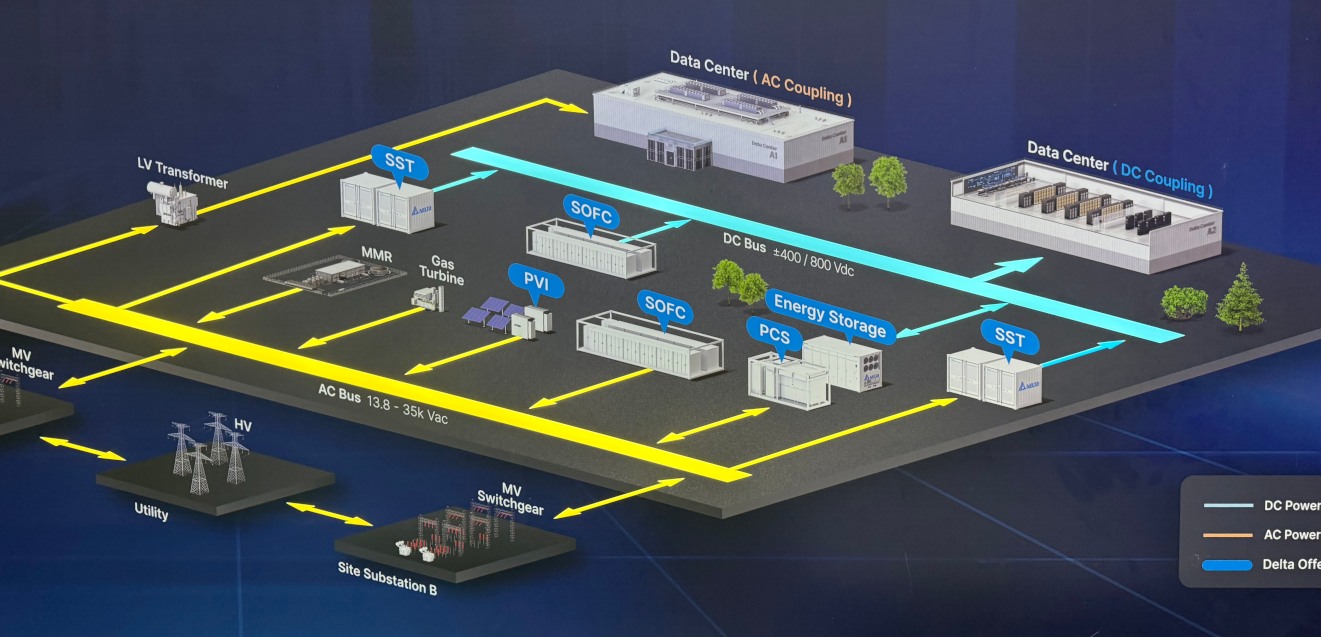
A rack drawing more than 100 kW is a fundamentally different animal from a conventional enterprise server rack, and the challenge isn't just installing bigger power supplies. Electricity has to be distributed, converted, and controlled across the whole system; higher current demands larger conductors and creates bigger losses; fluctuations have to be managed without destabilizing the rack; faults have to be isolated almost instantly. That power architecture — switchgear, transformers, uninterruptible power systems, rack-level power shelves, high-current busbars, voltage regulation, fault detection, sometimes battery storage — is exactly the territory where companies like Delta Electronics, Lite-On, and AcBel already have decades of experience in high-efficiency conversion and thermal management. Their role is only growing, because in some markets, the hardest constraint on AI data-center expansion is no longer getting enough GPUs. It's getting enough power to run them.
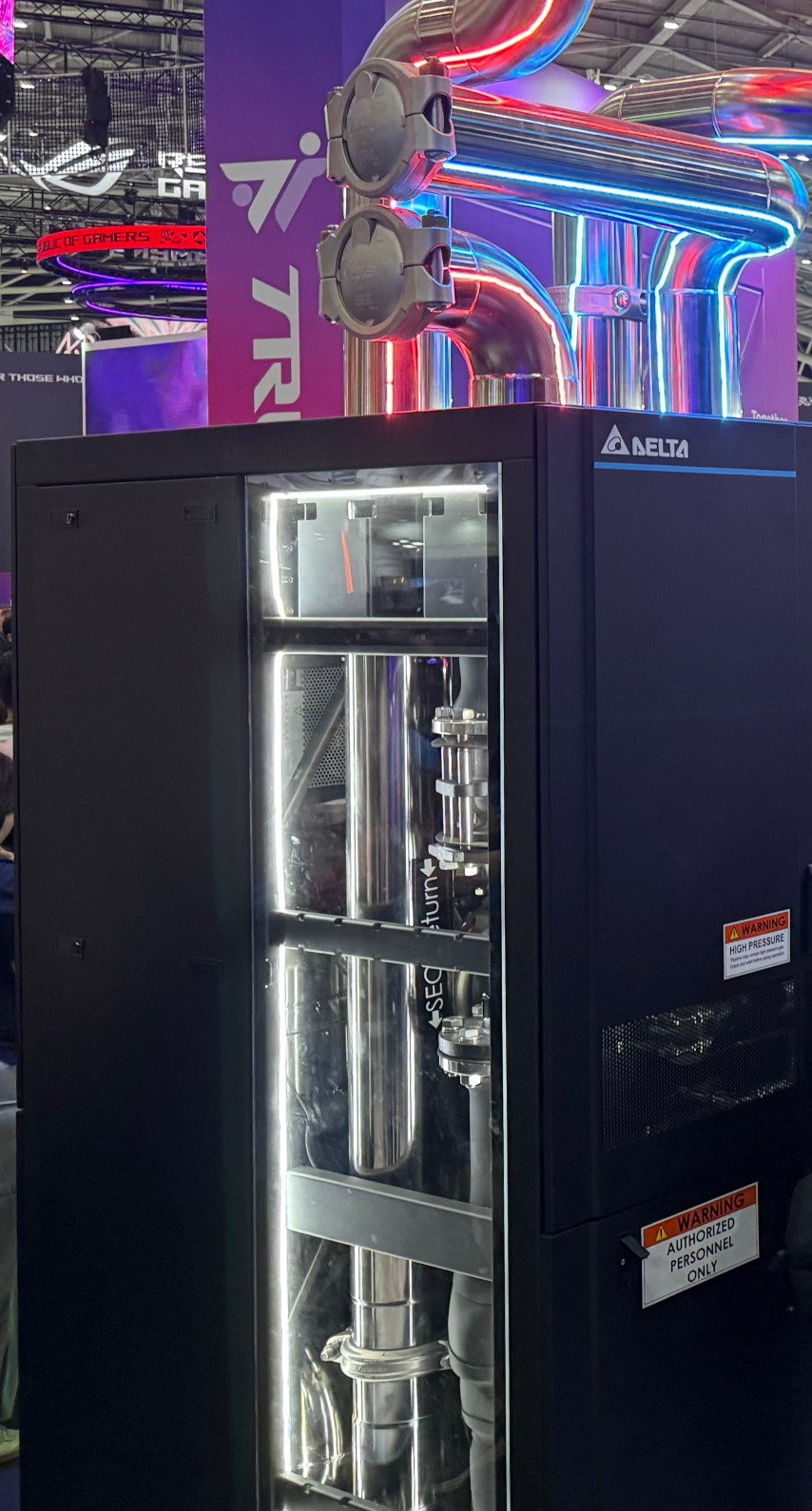
Cooling has undergone a similar transformation. Air cooling still works for plenty of server systems, but it becomes impractical fast as rack densities push past 100 kW. For platforms like the GB300 NVL72, direct-to-chip liquid cooling isn't an add-on — it's part of the computing architecture itself. Coolant circulates through cold plates attached to the hottest components, then passes through a coolant distribution unit into the building's facility-water system, with coolant temperature, flow rate, pressure, leak detection, and material compatibility all needing coordination between server designers, cooling-equipment suppliers, facility engineers, and software teams. A liquid-cooled rack has to be flushed, pressure-tested, and checked for contamination before it ever runs a workload, with firmware watching temperature, flow, and leak sensors the whole time it's in service. None of that can be developed in isolation from the board, the processor, the rack, or the power system it's meant to support — which is exactly why Taiwan's tightly networked ecosystem keeps proving so valuable.
AI clusters depend on more than one network
One detail overseas observers often miss: an AI cluster doesn't run on a single network, it runs on two. Inside a rack, NVLink and NVSwitch let 72 GPUs behave as one tightly coordinated computing domain — what the industry calls scale-up networking, where the priorities are raw bandwidth and near-zero latency. Across the wider data center, InfiniBand or high-performance Ethernet links racks together into clusters running into the thousands of accelerators — scale-out networking, where topology, congestion control, routing, and fault recovery matter more than any single link's speed. Faster processors alone don't guarantee better AI performance: a cluster with enormous theoretical compute can still perform poorly if data can't move efficiently between accelerators.
Optical connectivity will keep pushing closer to the compute as bandwidth needs grow, but copper isn't going anywhere — it still makes sense for short runs within trays and racks, while optical takes over for longer distances between racks and across data-center campuses. The future here isn't optical replacing copper wholesale. It's a boundary between the two that keeps shifting outward.
Advanced packaging connects the chip to the system
Industry discussion often jumps straight from fabrication to server manufacturing, which skips over one of Taiwan's most important advantages. Advanced AI processors depend on packaging technology sophisticated enough to connect the processor to high-bandwidth memory and move enormous amounts of data within the package itself — and packaging decisions ripple outward into board layout, power delivery, cooling design, mechanical tolerances, connector placement, and overall system reliability.
That means the AI supply chain isn't really a simple sequence of independent steps. It's a feedback loop: fabrication shapes packaging, packaging shapes board design, board design shapes power and cooling, thermal results shape mechanical design, and rack-level testing can force changes all the way back at the start. Taiwan's advantage comes from having so many of these capabilities sitting close to one another — not just production capacity, but the speed at which engineering information can move through the whole chain.
Manufacturing requires more than assembly
An AI rack isn't ready for delivery once the last component is installed — it has to be validated as a complete system, through electrical and signal-integrity testing, power-transient and thermal characterization, liquid-pressure and leak checks, firmware compatibility, cable and topology verification, accelerator and memory stress tests, burn-in, and full rack-level workload testing before it ships.
The hardest faults are usually the ones that cross subsystem boundaries. A networking problem might trace back to a cable, a connector, a switch, a firmware setting, or a thermal condition. A performance issue might be power throttling rather than the processor itself. A rack shutdown might start as a cooling problem that only shows up first as a software alert. This is where manufacturing experience becomes a genuine strategic asset — large ODMs accumulate enormous amounts of data on component histories, firmware versions, test results, and failure patterns, and that history helps them spot recurring problems across thousands of systems before they become field failures. The ability to test, diagnose, and continuously improve these systems matters just as much as the ability to build them in the first place.
Where overseas companies can participate
For overseas technology companies, Taiwan's AI infrastructure boom is a real opportunity — but getting in takes more than an impressive product and a search for a local distributor. The first question worth asking is: who actually owns the problem? A cooling-optimization product might need to be adopted by a thermal-equipment supplier, an ODM, or a data-center operator. A firmware-management platform might need buy-in from a server platform team. A network-observability tool might ultimately get specified by a hyperscaler rather than the Taiwanese company building the rack. A manufacturing-quality solution might be purchased by factory operations while the technical requirements come from an overseas customer entirely. Understanding that buying structure — before pitching anything — is essential.
The openings themselves cluster into a few areas. On the infrastructure side, there's room for baseboard management software, rack-management systems, firmware lifecycle tools, secure boot and device identity, and power capping. On the operations side, thermal monitoring, coolant-flow optimization, leak detection, capacity planning, and predictive maintenance are all live needs as liquid-cooled racks scale up. On performance, there's demand for tools that make sense of GPU utilization, network congestion, memory pressure, and power throttling across a cluster. And on the manufacturing floor itself, automated test orchestration, component traceability, and failure-pattern analysis are becoming table stakes as production volumes climb.
Where a product fits in that landscape determines the route to market — and for most overseas vendors, that route runs through local technical engagement rather than a purely commercial sales motion. Engineering teams want to understand how a product integrates with existing platforms, whether it can be customized, how it's supported, and whether the supplier can respond fast when something breaks. Documentation, local relationships, and access to actual decision-makers matter more here than a polished deck. So does patience: Taiwanese companies move quickly on engineering problems, but introducing a new supplier into a critical infrastructure platform can still mean months of validation and internal consensus-building before anything closes.
What overseas companies often misunderstand
A few misconceptions come up again and again. The first is assuming Taiwan's AI opportunity is mainly about selling to semiconductor companies — in reality it stretches across power, cooling, networking, manufacturing, testing, and operations, most of which has nothing to do with chip design at all. The second is treating Taiwanese ODMs as if they're primarily contract manufacturers; many now bring serious design, integration, and validation expertise to the table, and can influence platform architecture and supplier selection even when a major cloud customer writes the final spec. The third is assuming market entry is mainly a question of appointing a distributor — a distributor can help, but complex infrastructure products usually need direct access to engineering teams, local demonstrations, and a clear read on where purchasing authority actually sits. And the fourth is assuming one good customer relationship unlocks the whole ecosystem. Taiwan's supply chain is tightly connected, but it isn't a single organization — companies that cooperate on one project may compete on the next, and each relationship has to be built on its own terms.
Taiwan's advantage is coordination
Taiwan isn't the only place capable of manufacturing AI infrastructure. The US, Mexico, China, and Southeast Asia are all expanding their roles, and governments and large tech companies are pouring money into more geographically distributed supply chains. But building more factories doesn't automatically recreate an ecosystem. Taiwan's edge comes from the sheer concentration of complementary capabilities in one place — fabrication, advanced packaging, board and substrate manufacturing, power electronics, thermal engineering, server design, rack integration, manufacturing, validation, and global logistics — held by companies with decades of experience responding to fast product transitions and demanding international customers.
That experience matters more than ever because AI platforms are changing at an unusual pace. New processor generations can force changes to cooling, power, networking, and system architecture all at once. Production capacity has to expand while designs are still being finalized. Customers expect suppliers to solve hard technical problems without ever slipping the deployment schedule. Taiwan's ecosystem was effectively built for exactly this kind of coordination, long before anyone called it an AI supply chain.
AI is physical
To most users, artificial intelligence looks like software. Behind it sits one of the most complex industrial systems being deployed anywhere today — advanced processors, high-bandwidth memory, enormous electrical capacity, liquid cooling, high-speed networking, and manufacturing processes stitching together thousands of components with almost no room for error.
Taiwan's importance lies in its ability to connect all of those layers. Its semiconductor industry makes many of the processors at the center of the AI economy. Its packaging companies connect those processors to memory. Its component makers build the boards, connectors, cooling systems, and power equipment. Its ODMs integrate everything into complete platforms and manufacture them at global scale. Increasingly, the final systems may be assembled in Texas, Mexico, or Southeast Asia — but the engineering networks, supplier relationships, and integration knowledge behind them stay deeply rooted in Taiwan.
For overseas companies, that's both the opportunity and the challenge: access to one of the world's most capable AI infrastructure ecosystems, and the work of figuring out where you fit inside it, who owns the problem you're trying to solve, and how to build the technical and commercial relationships needed to actually participate. The decisive question is no longer just who can design the fastest chip. It's who can turn that chip into a reliable, cooled, powered, connected, and serviceable computing system. Right now, Taiwan is one of the best places in the world at doing exactly that.