
In a recent BBC interview, TSMC's chief financial officer, Wendell Huang, was asked the question hanging over the entire global push to reshore chipmaking: could TSMC's overseas fabs ever match the ones in Taiwan? His answer was unusually direct. The most cutting-edge production would stay in Taiwan, and moving the full manufacturing ecosystem abroad, he said, would take five or ten years — or even longer.
On 16 July 2026, that claim got its sternest test. At TSMC's second-quarter earnings conference, Chairman C.C. Wei announced an additional US$100 billion for Arizona, taking the company's planned investment there to $265 billion — four or more wafer fabs and advanced packaging, built for "2-nanometer and more advanced processes." The U.S. Commerce Department put TSMC's planned American footprint at twelve leading-edge chip and packaging facilities.
That sounds like the frontier moving west. Read the rest of the same press conference, though, and it looks like something else. Wei also confirmed that A14 — the generation after 2nm — enters commercial production in 2028, with A13 and A12 following in 2029. All of it in Taiwan. And he gave no timetable at all for the $100 billion.
That asymmetry is this article's subject. Taiwan's lead is partly a thing that can't be copied quickly, and partly a thing TSMC and its government are choosing not to hand over. Both halves matter, because only together do they explain why the newest chip you can buy will, for the foreseeable future, have been born in Taiwan.
The one-hour ecosystem
Picture a leading-edge fab and you probably imagine a single vast building. In reality a fab produces nothing on its own. It sits at the center of a dense web of suppliers feeding it in real time: equipment vendors and the technicians who install and repair the machines, industrial gas and specialty-chemical suppliers, photomask shops, testing and advanced-packaging houses, wafer and raw-material vendors, plus the customers and chip designers who want to be nearby, and the utilities that run it around the clock.
In Taiwan, almost all of that sits within driving distance. TSMC's co-COO, Cliff Hou, described it at SEMICON Taiwan 2025 as a "one-hour semiconductor ecosystem": the company can source nearly anything it needs within an hour. That density isn't a convenience — it's what keeps yields high. Fabs run 24/7, and when a machine drifts or a part fails, getting an engineer or replacement on-site within the hour is the difference between a good quarter and a scrapped one.
The concentration is remarkable. By SemiAnalysis's account, Hsinchu Science Park alone accounts for roughly 60% of Taiwan's semiconductor output value and hosts around 189 semiconductor-related companies, including 95 IC design firms and 17 testing-and-packaging houses. The maximum distance between any two TSMC fabs in Taiwan is under three hours by car, and most of the company's tier-one suppliers run factories on the island. Move the fab abroad and you inherit the building in the middle without the ring around it.
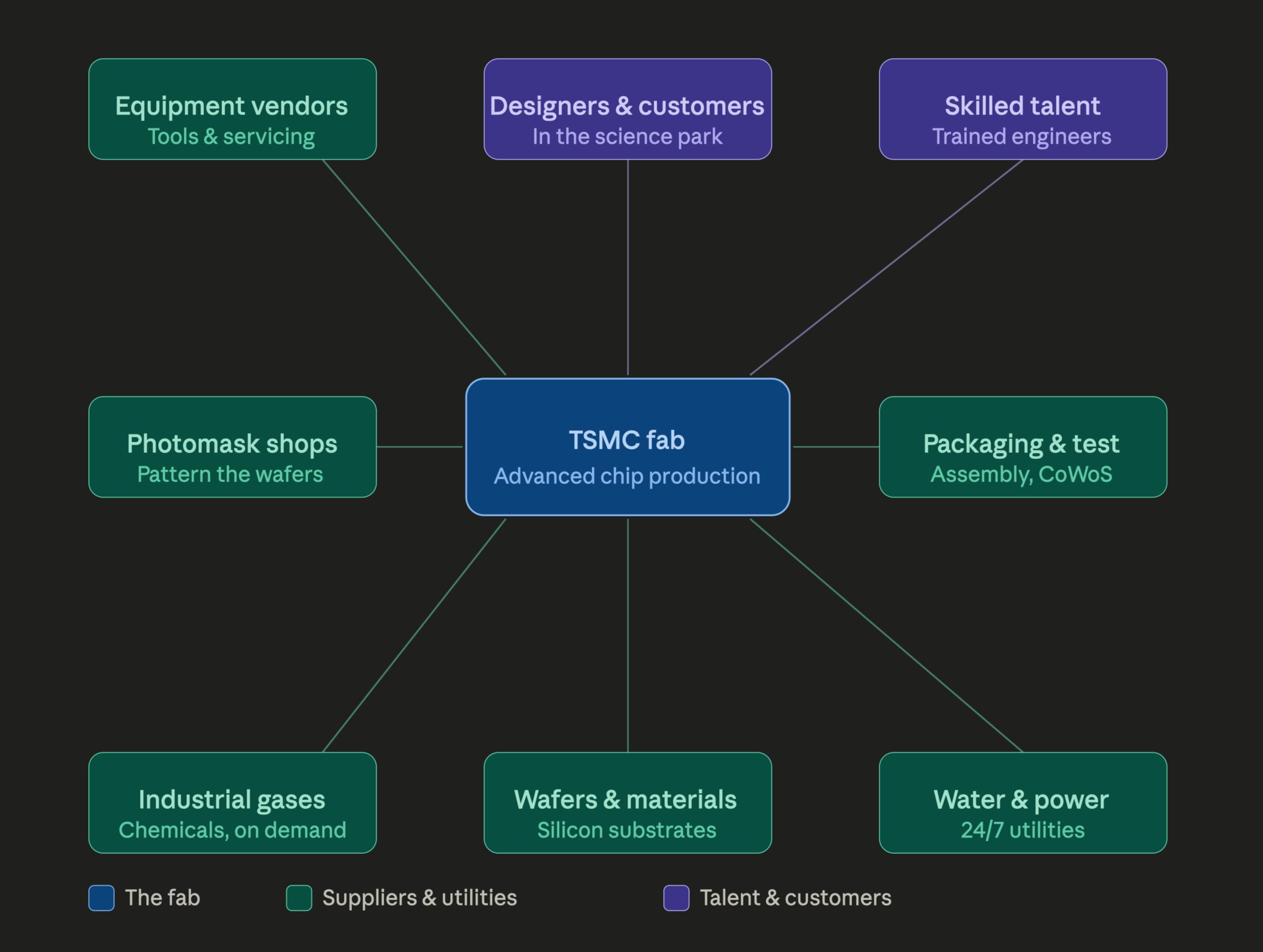
Arizona is the live experiment in how hard that ring is to rebuild, and the risk isn't hypothetical. In Taiwan, industrial gases are handled through TSMC's own in-house systems; in Arizona they're outsourced to a third party, Linde. In September 2025, a power fault at Linde’s gas facility interrupted the supply of process gases to TSMC Arizona, temporarily halting production and forcing the fab to scrap thousands of wafers. The incident may have contributed to the subsidiary’s third-quarter profit falling to $1.4 million from $140 million, although TSMC said its profitability was affected by multiple factors. In Taiwan's cluster, that dependency is absorbed by redundancy and proximity.
The bottleneck of the moment makes the same point. Advanced packaging (CoWoS, the technology that stitches AI accelerators together with CPUs and high-bandwidth memories) is in tight supply industry-wide. Wei said TSMC is developing an alternative IC assembly technology alongside CoWoS, about a year from commercial production, and added that he would be glad to see more manufacturers invest in advanced assembly. Packaging capacity is not a commodity you can order; it is a piece of ecosystem, and it is concentrated where the ecosystem is.
The flywheel that stays home
The second moat is slower to see but harder to copy: TSMC's brain stays in Taiwan too. The company's R&D center sits in Hsinchu, in the middle of the same cluster that houses the fabs, designers, and suppliers who will actually run each new process. Developing a node next door to the fabs that will manufacture it shortens the loop between inventing a process and mass-producing it from a transpacific flight to a car ride.
That's reinforced by how deeply TSMC is wired into Taiwan's universities. With government backing, the company runs dozens of semiconductor programs across seventeen local universities (57 by SemiAnalysis's count) spanning everything from fundamental science to advanced packaging. It goes further than sponsoring courses: TSMC provides process design kits (PDKs) for educational use, so students learn on the same process-design rules and chip-design workflows they'll use professionally and arrive fab-ready.
The result is a self-reinforcing flywheel. Close to 90% of TSMC's 83,000-plus employees are Taiwanese, and roughly 87% work in Taiwan. The universities feed the fabs; the fabs and the co-located R&D center push knowledge, tooling, and methods back into the universities; and the whole loop turns inside the same one-hour radius, compounding year after year.
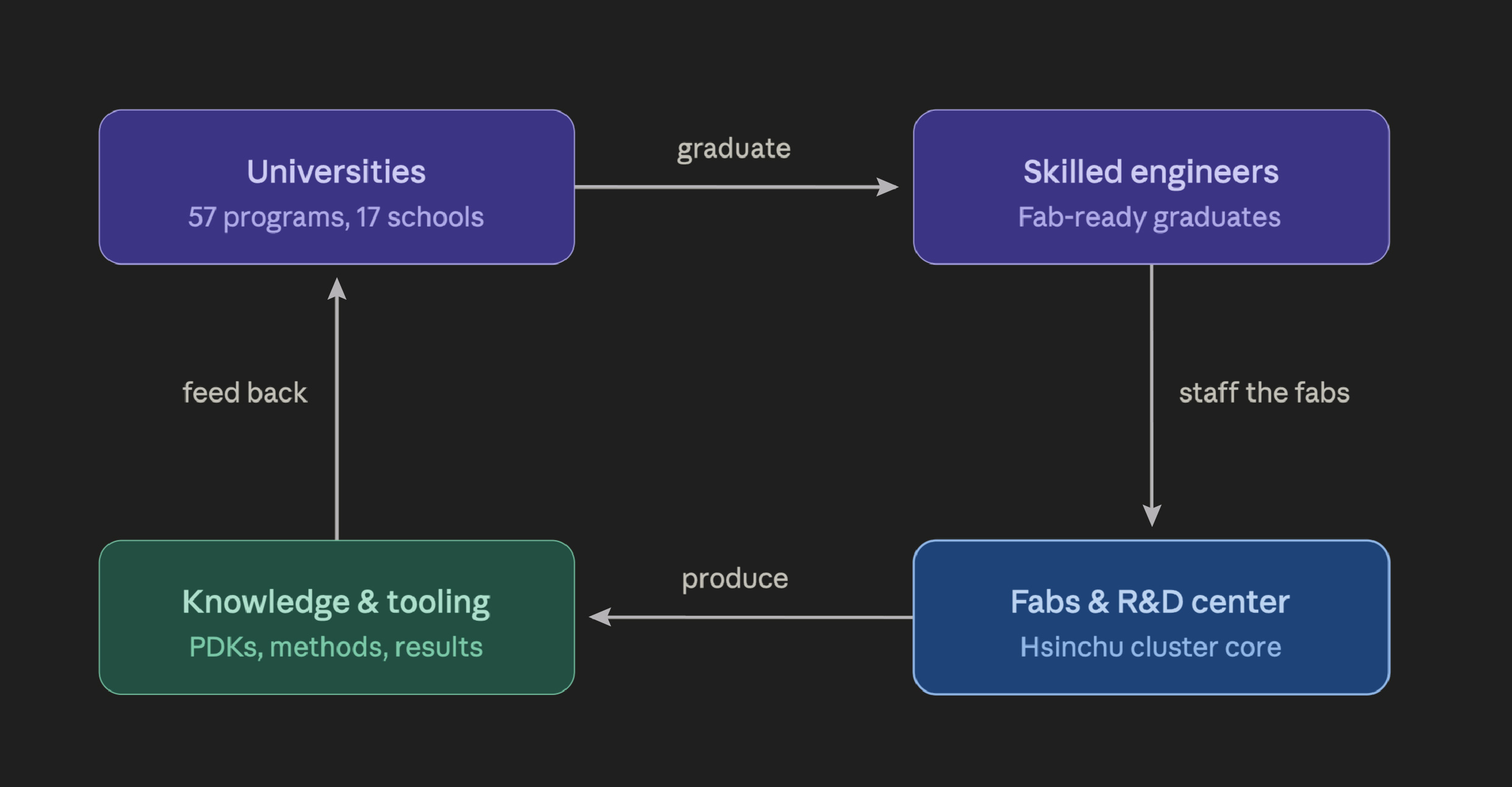
This is the piece money and urgency can't fast-forward. A fab abroad can borrow Taiwan's engineers temporarily by flying them in. It cannot yet borrow Taiwan's university pipeline or the compounding effect of having the R&D center next door. A building can be poured in two years; a research-and-talent ecosystem is the product of decades of coordinated investment between a company and a state.
It also still pulls inward. Taiwan's Cabinet noted this month that foreign firms including Nvidia, AMD and Micron continue to expand their operations in Taiwan; a reminder that the cluster is not merely exporting capacity but attracting it.
The frontier keeps moving
Put the process nodes on a timeline and the pattern is unmistakable: Taiwan reaches each new node first, and the overseas fabs pick it up years later.
According to TSMC's own technology pages, the company was first to high-volume 7nm in 2018, first to 5nm in 2020, first to 3nm FinFET process in 2022, and it began 2nm volume production in the fourth quarter of 2025 — a roughly two-three year cadence, with every TSMC node initially ramped in Taiwan.
Abroad, the picture is more advanced than it used to be, and it's worth being precise about it. In Arizona, the first fab is in mass production on 4nm; construction is complete on the second, which will run 3nm with mass production scheduled for the second half of 2027; the third is under construction, ground has been broken on the fourth, and work on the first advanced packaging plant is expected to begin in 2027. TSMC is also adding three 3nm fabs — one each in Taiwan, Arizona and Japan — and converting some 5nm equipment in Taiwan to support 3nm. Japan's JASM, which began high-volume production in 2024 on legacy 28nm and 16nm for specialty and automotive customers, is no longer purely a trailing-edge site. Germany's ESMC remains a 28/16nm plant in construction.
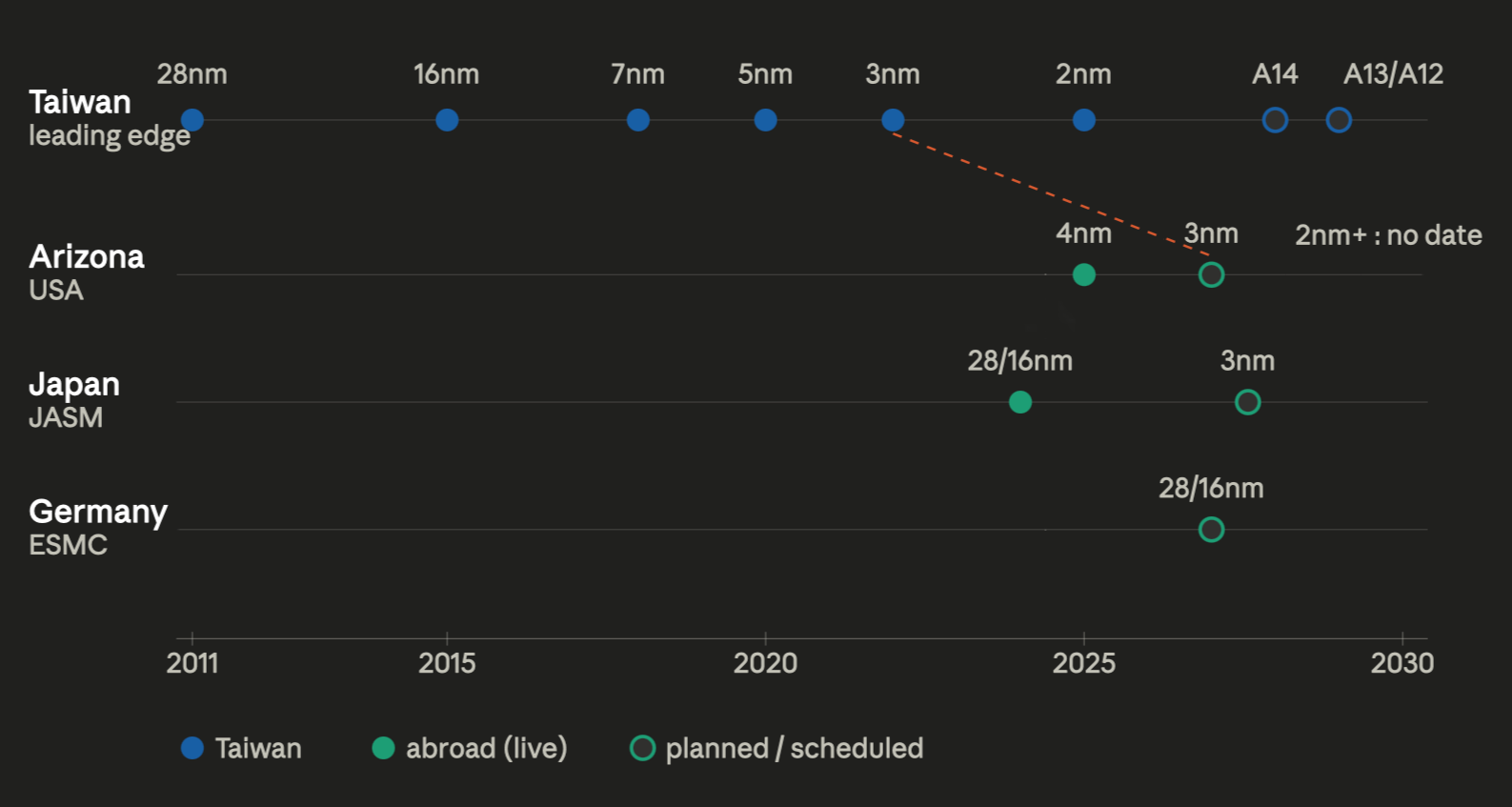
So the old shorthand — overseas fabs are permanently two generations behind — no longer quite holds, and an honest article should say so. What replaces it is more interesting.
Start with the mechanism. TSMC develops and ramps each node to mature yield in Taiwan, alongside its R&D center, and then transfers the proven, de-risked process abroad. An overseas fab doesn't pioneer a node; it receives one that Taiwan has already made reliable. That yield-learning sequence is the actual engine of the gap.
Then add the roadmap. At the same July conference where he announced the Arizona expansion, Wei confirmed that A14, the second generation of TSMC's nanosheet transistor technology, enters commercial production in 2028, offering a 10–15% speed gain at the same power or a 25–30% power reduction at the same speed, with logic density up almost 20% over 2nm. He said A14's production scale will exceed 2nm's, and that this should cement TSMC's technological lead. A13 and A12 are slated for 2029.
Now set that against Arizona. The new fabs are for "2nm and more advanced" processes — genuinely leading-edge on paper. But asked whether the $100 billion would be spent over three years or five, Wei declined to give a firm timetable, saying progress depends on market conditions and customer demand, and that TSMC would move "as fast as possible." That's a commitment without a date, against a Taiwan roadmap with dated nodes through 2029.
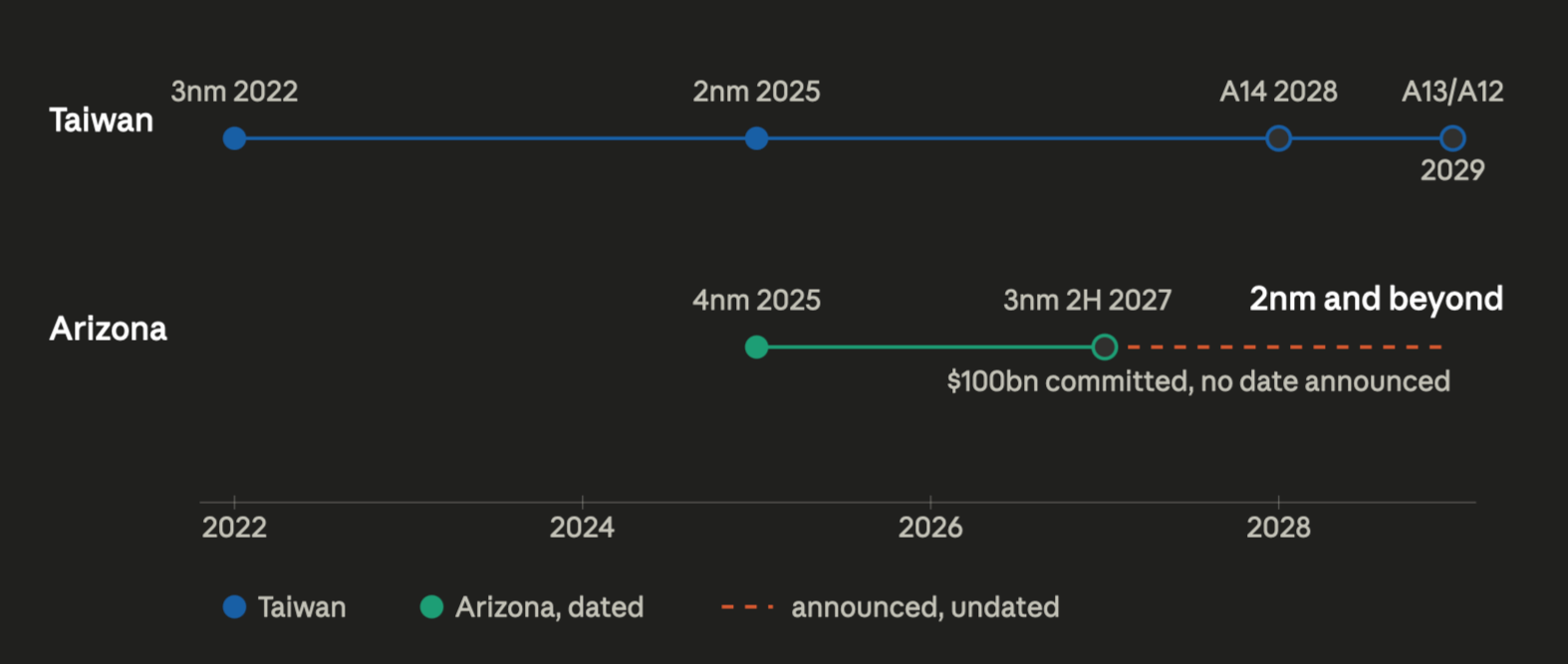
That is the real shape of the lead. It isn't that Arizona is frozen a fixed number of generations back — it's that Taiwan's frontier keeps advancing on a published schedule while the overseas buildout advances on demand. Chasing a moving target is a different problem from closing a fixed gap, and it's why Huang's "five or ten years, or even longer" was a serious answer rather than a deflection.
The economics point the same way
Even if you set the ecosystem and talent aside, the math still argues for keeping the most advanced, highest-volume production in Taiwan.
TSMC now quantifies the penalty itself: Wei has said the ramp-up of overseas fabs is expected to dilute gross margin by 2–3 percentage points in the early stages, widening to 3–4 points as overseas operations scale. That is a company-stated, recurring cost of manufacturing outside the cluster. It echoes what founder Morris Chang warned in 2023, when he put Arizona's chip costs at roughly 50% above the Taiwan line — possibly closer to double, by later reporting.
Some of the gap is regulatory. By SemiAnalysis's account, US permitting takes about twice as long as Taiwan's, where certain approvals carry maximum time limits precisely so strategic projects aren't held up. And Taiwan's government is actively removing friction at home: the Cabinet says it is securing land for TSMC's future domestic investments and supporting the water, electricity and energy infrastructure those fabs need.
Higher cost per wafer is an independent reason to treat overseas fabs as strategic capacity rather than the frontier. You put your most cost-sensitive, highest-volume, leading-edge output where it is cheapest and most reliable to make. Notably, TSMC raised its 2026 capital expenditure budget to $60–64 billion, with 70–80% earmarked for advanced process technologies — the spending is following the leading edge, wherever the leading edge lives.
Not just "can't" — also "won't"
Everything above explains why Taiwan's lead is hard to copy. But the word always needs a second leg: Taiwan is also choosing to keep the crown jewels at home, and this month it said so out loud.
Hours after the Arizona announcement, Taiwan's government stated it would work to ensure TSMC's most advanced technology remains in Taiwan. Cabinet spokesperson Michelle Lee pointed to Wei's parallel commitment — 13 leading-edge and advanced packaging fabs in Taiwan over the next several years — as helping ensure Taiwan remains home to most of TSMC's manufacturing capacity and its most advanced technology. Lee framed the government's role plainly: it is prioritizing keeping a complete semiconductor ecosystem in Taiwan.
The scale backs the rhetoric. The Ministry of Economic Affairs says TSMC currently operates 19 advanced process and packaging facilities in Taiwan and is expanding further, which will keep its advanced-process capacity at home far larger than overseas. Earlier in July, Economic Affairs Minister Kung Ming-hsin had argued the United States is unlikely to match TSMC's Taiwan capacity at all, citing sixteen announced fabs and CoWoS packaging facilities on the island; however, many plants get built in America, he said, it won't be that many.
Underlying this is the "silicon shield": the idea that Taiwan's indispensability to the world economy is itself a form of security. Officials handle the term carefully, wary of cross-strait provocation, but the logic runs straight through the policy. The more the frontier of chipmaking depends on Taiwanese soil, the stronger Taiwan's position. That gives both company and government an active reason to keep the newest node at home, not merely to let it happen because rivals lag, but to make it happen by design.
The honest counterpoint
None of this means the overseas fabs are failing.
Arizona's early results have been encouraging. TSMC Arizona's leadership reported that initial yield in Phoenix ran a few percentage points higher than comparable Taiwan fabs, but with caveats: the 4nm process had been in volume production in Taiwan for over two years, and the early product mix leaned toward smaller, higher-yielding chips. A positive signal, but not proof that the gap has closed.
There is also a real argument for proximity, and it comes from the American side. AIT Director Raymond Greene called the $100 billion pledge a powerful signal of trust in the U.S.–Taiwan partnership, arguing that it allows TSMC to operate closer to its largest American customers and respond faster to demand. "Being closer to the customer matters," he said, enabling TSMC to move at market speed as AI and high-performance computing reshape industries. For customers concentrated in the United States, that is not nothing.
The political pull is real, too. The commitment followed a U.S.–Taiwan trade agreement that cut tariffs on Taiwanese goods to 15% in exchange for $250 billion in planned Taiwanese investment, and landed about two weeks after President Trump told Fox Business that TSMC was doubling the size of its Arizona operations. Trump has claimed the United States will hold half of global semiconductor manufacturing capacity by the end of his term in 2028 — though experts have said that is impossible. Commerce Secretary Howard Lutnick framed the investment as bringing advanced manufacturing back to America.
Even Greene, though, conceded the anchor point: he argued Taiwan will remain the center of the semiconductor industry even as TSMC expands abroad, citing Taiwan's semiconductor output rising from about NT$4.3 trillion in 2023 to a projected NT$8.4 trillion in 2026. The island isn't shrinking as it exports capacity. It's growing faster.
So the honest framing isn't "overseas fabs can't work." It's that closing the gap: ecosystem, talent, yield, cost, and a frontier that keeps advancing is a five-to-ten-year project at best, against a target Taiwan has every incentive and every capability to keep moving.
The bottom line
Relocating a fab moves one node in a graph. The value lives in everything around it: the hour-away suppliers, the university pipeline and R&D center compounding over decades, the yield-learning that happens at home first, and a cost structure that rewards keeping the leading edge where the ecosystem already is. Layered on top is the company's and the government's deliberate strategy to keep the frontier home.
July 2026 showed both halves at once. TSMC committed another $100 billion to Arizona, for fabs at 2nm and beyond, with no date attached. In the same breath, it confirmed A14 for 2028 and A13 and A12 for 2029, and thirteen more leading-edge and advanced-packaging fabs in Taiwan. One of those is a promise. The other is a schedule.
When TSMC's CFO says matching Taiwan would take five or ten years or longer, he isn't describing a construction timeline. He's describing how long it takes to grow an ecosystem, and quietly noting that by the time anyone gets there, Taiwan will have moved again.